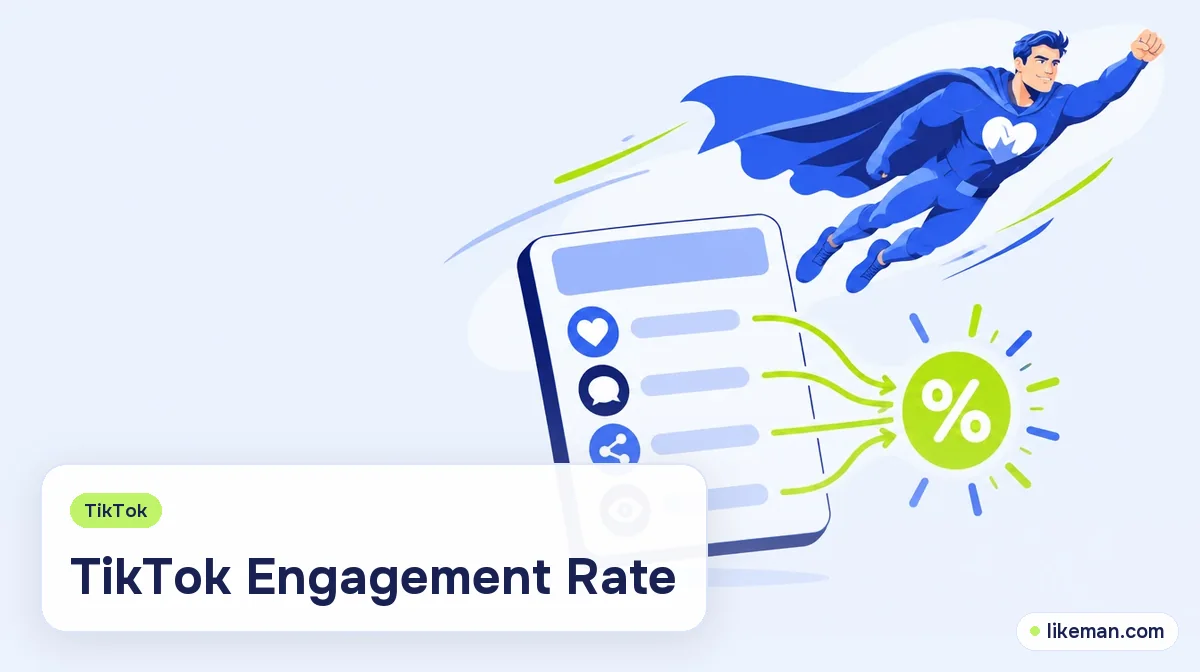
TikTok engagement rate is the share of people who reacted to a video. The simplest version is (likes + comments + shares + saves) ÷ views × 100. Another divides by followers. Benchmarks vary by source and account size, so measure each video against your own median not a universal number.
Brands, agencies and creators all ask for an engagement rate, but they do not all use the same formula. This guide shows three common ways to calculate it, a worked example you can copy into a spreadsheet, why published benchmarks disagree and a plan for raising the number over two weeks.
What counts as engagement?
On TikTok, engagement actions usually include likes, comments, shares and saves. Some analysts also count follows and profile visits, but the first four are the common set. Views are the base for the most useful formula, because they show how many people had the chance to react.
Three formulas
| Formula | Calculation | Best used for |
|---|---|---|
| By views | (likes + comments + shares + saves) ÷ views × 100 | Judging a single video |
| By followers | (likes + comments + shares + saves) ÷ followers × 100 | Comparing accounts or sponsor pitches |
| By reach | interactions ÷ accounts reached × 100 | Business analytics where reach is available |
TikTok's own analytics show the counts you need. The by-views version is easiest and most honest for small accounts, since a video can reach many more people than you have followers.
A worked example
Take a video with these numbers:
- Views: 12,000
- Likes: 540
- Comments: 36
- Shares: 48
- Saves: 76
Total interactions: 540 + 36 + 48 + 76 = 700.
By views: 700 ÷ 12,000 × 100 = 5.8 percent.
If the account has 4,000 followers, by followers the rate is 700 ÷ 4,000 × 100 = 17.5 percent. The second number looks larger because the video reached beyond the follower base. That is why you must say which formula you use whenever you share a rate with a brand.
Copy this into a spreadsheet: one row per video, columns for views, likes, comments, shares, saves, followers at posting time and the two rates. Add a column for the median of the last ten videos.
What is a good engagement rate on TikTok?
Published benchmarks differ because they use different formulas, accounts and years. Commonly quoted figures for the by-views version range from a few percent to above ten percent, with small accounts often scoring higher than large ones. Treat any single number with caution. A more useful approach:
- Compute the rate for your last ten videos.
- Find your median.
- Call a video strong if it is above 1.5 times your median, and weak if it is below half.
- Repeat monthly.
If a sponsor asks for a number, give them your median and your best and worst, together with the formula.
Why rates differ between accounts
- Account size. Large accounts reach more casual viewers, who react less.
- Niche. Educational and community topics often score more saves and comments than pure entertainment.
- Video length. Short loops attract replays but fewer comments.
- Audience age and region. Habits vary.
- Paid reach. Promotion adds views from people who did not choose to see you, which lowers the rate.
Engagement rate versus reach
A high rate on a tiny reach is not a win, and a low rate on a huge reach is not a loss. Look at both: if a video reached 200,000 people at 2 percent, that is 4,000 interactions; if it reached 2,000 at 8 percent, that is 160. Rate tells you about quality, reach tells you about scale.
12 steps to improve it, with a metric each
- [ ] 1. Hook in the first second. Metric: retention at second three.
- [ ] 2. One idea per video. Metric: completion rate.
- [ ] 3. Give a payoff worth a tap. Metric: likes per 1,000 views.
- [ ] 4. Ask one specific question. Metric: comments per 1,000 views.
- [ ] 5. Include a tip friends would forward. Metric: shares per 1,000 views.
- [ ] 6. Offer a list or recipe worth keeping. Metric: saves per 1,000 views.
- [ ] 7. Reply in the first hour. Metric: replies.
- [ ] 8. Use on-screen text and captions. Metric: watch time.
- [ ] 9. Post when followers are active. Metric: first-hour views.
- [ ] 10. Make a series. Metric: rate on part two.
- [ ] 11. Pin your best comment. Metric: comment count.
- [ ] 12. Reuse whatever your top three videos had in common. Metric: share of posts that beat the median.
Two-week plan
- Days 1 and 2: build the spreadsheet and compute your median.
- Days 3 to 5: publish three clips that open on the result; compare retention.
- Days 6 and 7: add a question to two videos; compare comments.
- Days 8 to 10: add a save-worthy list to two videos; compare saves.
- Days 11 and 12: reply to every comment within an hour; compare rates.
- Days 13 and 14: compare all rates with your median and pick what to repeat.
Our guide on views, likes and followers shows how the counters relate, and TikTok post times helps with the timing step.
How brands read your rate
Sponsors usually look at three things: median views, engagement rate by views and the audience's country. They want to know that your audience reacts, that it is not inflated and that it matches their buyers. A tidy one-page summary with your median views, median rate by views, best and worst recent videos and two examples of previous brand work answers most questions. If your rate is lower than their guidelines, point to saves and shares, which often show stronger intent than likes.
Quick benchmark worksheet
Write down your last ten videos in a table. Mark the three with the highest rate and the three with the lowest. For each group, note the topic, length, opening line, posting time and call to action. Look for repeating patterns: perhaps your highest-rate videos all answer a question in the first line, while the lowest are long stories with slow starts. Write one rule from each group and apply them to your next five videos. This worksheet takes fifteen minutes and tells you more than any published benchmark.
Common mistakes with the calculation
- Dividing by followers for one video that went far beyond your followers.
- Mixing paid and organic views in one rate.
- Using a different formula each month, so trends are meaningless.
- Ignoring saves and shares, which are the best signs of value.
- Comparing your rate with an influencer who has a different niche and size.
- Judging a video's rate in its first hour, before the views settle.
When the rate is high but growth is slow
A high rate with few views means the video pleases those who see it but is not shown widely. Improve discovery: clearer topic words, search terms in captions and posting times. When the rate is low but views are high, the video reaches people but fails to move them, so strengthen the payoff and add a reason to react. Treat the two numbers as a pair: the best plan raises both over time without sacrificing either.
Do bought likes improve the rate?
Added likes can push the like count up, but they do not add watch time, comments or saves, and an unusual ratio is easy to spot. Brands who ask for your analytics will see the mismatch. If you use a small starting number, keep it in proportion to the views and let real viewers do the rest.
How it works at LikeMan
Brand-new videos can look flat without any reactions. LikeMan TikTok likes are ordered with a public video link, without a password. The total appears before payment, work begins once the payment is confirmed and a loss in the following year is replaced. They change a counter; they don't raise genuine engagement. See other options under TikTok.
FAQ
How do you calculate TikTok engagement rate?
Add likes, comments, shares and saves, divide by views and multiply by 100. You can divide by followers instead.
What is a good engagement rate on TikTok?
It depends on formula and account size. Compare with your own median and aim to beat it.
Is engagement rate more important than views?
They answer different questions: views show scale, engagement shows reaction.
Do likes alone make the rate?
No. Comments, shares and saves count too.
Conclusion
TikTok engagement rate is a ratio of reactions to views or followers. Choose a formula, say which one you use, track your median and improve one habit at a time with the two-week plan.